
In 2026, EDGG will organise two Field Workshops: the 22nd EDGG Field Workshop, focused on the dry grasslands of North-Eastern Poland, will take place on 24–30 May 2026; and the 23rd EDGG Field Workshop, to be held in the Pirin Mountains (Bulgaria) on 14–18 July 2026, will focus on all open habitats of the subalpine and alpine belts. For details on the 23rd Field Workshop in Bulgaria, see the dedicated page.
22nd EDGG Field Workshop: Syntaxonomy and diversity of dry grasslands of North-Eastern Poland, 24 – 30 May 2026
The 22nd EDGG Field Workshop will be held in North-Eastern Poland, at the location where Central, Eastern and Northern Europe meet, leading to the unusual diversity of habitats but also the possibility to contribute to unifying phytosociological classification systems across the continent. We will use the standardized, high-quality vegetation-plot sampling of EDGG (Dengler et al. 2016) to record vegetation composition, structural and environmental parameters across dry grasslands open habitats in the north-eastern corner of Poland. We will mainly sample standard 10-m² plots (to be used for vegetation classification) and from time to time nested-plot series (ranging from 1 cm² to 100 or 1000 m², “EDGG Biodiversity Plots”) (for biodiversity studies with the GrassPlot database). In both cases, we will carefully sample not only vascular plants, but also bryophytes and lichens, and collect soils. The focus is on the dry grassland classes Koelerio-Corynephoretea and Festuco-Brometea, but we will also record some stands of the “neighbouring” classes Molinio-Arrhenatheretea, Nardetea strictae and Trifolio-Geranietea.
Our main goal is to supplement our existing extensive database of standardised 10-m2 plots (more than two hundred plots) collected in the region during the recent years by several EDGG members (see e.g. Dembicz et al. 2025a), enabling completion of a comprehensive scientific publication on the syntaxonomy (and biodiversity) of the dry grasslands of North-Eastern Poland. In the longer perspective, we also plan a comprehensive classification of the dry grasslands in entire Poland, combining the NE Polish dataset with those from South Central Poland (8th EDGG Field Workshop 2015; see Kącki et al. 2014), the Lesser Polish Uplands (Dembicz et al. 2025b) and additional data to be sampled in North, West and South-East Poland during the coming years. The collected data will be contributed to the GrassPlot database (Dengler et al. 2018) and serve as the basis for more broad-scope scientific publications on diversity of Eurasian grasslands, as has been done in previous EDGG Field Workshops (e.g. Birrun et al. 2021, Dembicz et al. 2021).
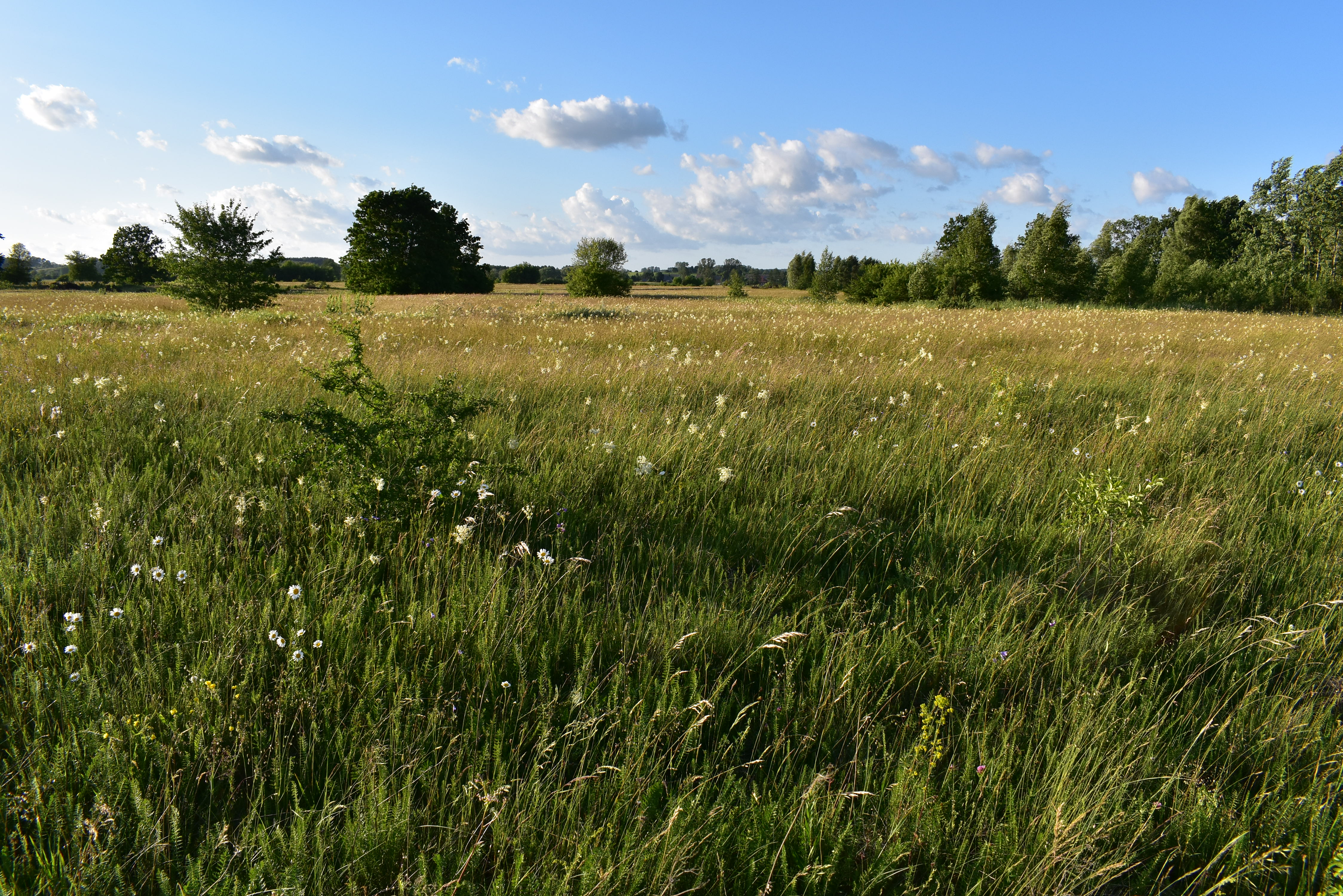
Meso-xeric grasslands with Filipendula vulgaris, Galium verum and Briza media in middle Narew valley (Photo: I. Dembiz).
Study area
The Field Workshop will take place in the north-eastern part of Poland from the capital Warsaw to the Polish-Lithuanian border. During the expedition we will travel north and east up the Narew river and its tributaries. On our way we will encounter sharp climatic gradients with increasing continentality but also lowering mean annual temperature (from 9.0 °C in Warsaw to 7.2 °C in Suwałki), increasing winter severity and to some extent also increasing precipitation (from 550 mm in Warsaw to 607 mm in Suwałki) (data for the period 1990-2020, https://klimat.imgw.pl/en/climate-normals). The Polish-Lithuanian border marks the division between the Continental and Boreal biogeographic regions (European Commission 2013) but in the Polish tradition the north-easternmost part of the country was already regarded as belonging to the hemiboreal zone due to the presence of some typical boreal elements among its flora, fauna and vegetation types (Kondradzki 1968; Szafer 1977).
The landscape of the area was shaped by the Pleistocene glaciations which covered it with up to 200 m thick deposits made of till, sands and gravels. The southern part of the region was not glaciated during the Last Glacial Maximum (Embelton 1984) and the main feature of its landscape, besides eroded glacial plains, are periglacial valleys once transporting the meltwaters and waters of Neman, Narew, Bug and Vistula westwards towards the North Sea. Those valleys, sometimes deeply craved into the surrounding moraines, are covered with both Pleistocene and Holocene fluvial sandy deposits (Kasprzak et al. 2024), which supported the development of dry grasslands of various types. The northern part of the area, belonging to the Lithuanian Lakeland region, was glaciated during the Last Glacial Maximum. Accordingly, it has a much more diverse landscape with hilly moraines reaching up to 300 m a.s.l., and a diversity of glacial landforms such as winding eskers, kames, deep craved lakes or extensive sandy outwash plains (Smolska et al. 2024).
The landscape of the region, once covered with extensive oak-hornbeam forests, has been gradually transformed by humans since the early Middle Ages. As this area was a transition zone between orthodox east and catholic west and as in the north-eastern part of the region, one of the last not Christianized tribes of Europe, Baltic Yotvingians, persisted until the 14th century this transformation has been lagging in the region compared with the rest of the country (Czerwiński et al. 2022). This backwardness was attributed to the region later on and led to the exceptionally well-preserved nature, both natural and semi-natural communities, persisting there until the end of 20th century. However, since that time, despite the creation of many nature conservation areas protected under the EU Natura 2000 directives, the land abandonment on one hand and the intensification and modernization of agriculture on the other had led to a decline of the area and quality of grassland habitats of the region, which is still ongoing (Korzeniak et al. 2025). Thus, one of the additional goals of our expedition is to document the diversity of the grasslands of the region before they are lost.
As the dry grassland research in Poland was predominantly developing in southern and western Poland, until the second half of the 20th century it has been focusing mostly on Festuco-Brometea stands in the abovementioned regions (Medwecka-Kornaś 1959, Ceynowa 1968, Filipek 1974). After this period some studies on sandy grasslands (Koelerio-Corynephoretea class) were conducted in the post-glacial landscapes of Poland (Głowacki 1988, Czyżewska 1999, Dembicz et al. 2025) but the region of the workshop is still not thoroughly studied. Even less was known about the Festuco-Brometea communities of the North-Eastern Poland with the exception of the publication of Skolołowski & Kawecka (1984). The significance of the region for dry grassland ecosystems (both from Festuco-Brometea and Koelerio-Corynephoretea classes) was only recognized after establishment of Natura 2000 network, which was coupled with more comprehensive surveys (Obidziński 2010). However, no the syntaxonomic revisions were carried out, leading to strong confusion whether some of the grasslands here should be placed in the Kolerio-Corynephoretea, Festuco-Brometea, Trifolio-Geranietea or Molinio-Arrhenatheretea and the respective habitats 6120, 6210 or 6510 of the Habitats Directive (Interpretation Manual 2013). Moreover, just a few hundred kilometres from our study area eastern European phytosociologists classify similar river-valley meso-xeric communities into the alliance Agrostion vinealis, currently placed in the order Galietalia veri and the class Molinio-Arrhenatheretea. Thus, all syntaxonomic information in the following text should be considered as preliminary − as the formal classification of the communities is the main goal of the workshop.
The main grassland types to be sampled during the workshop include pioneer sandy grasslands on acidic to neural valley and glacial sands and gravels rich in therophytes and lichens (alliances Corynephorion canescentis, Sileno conicae-Cerastion semidecandri and Koelerion glaucae) and mesoxeric grasslands on sandy but also finer-grain neutral to basic substrates of valley bottoms (alliances Filipendulo vulgaris-Helictochloion pratensis, Armerion elongatae and maybe Agrostion vinealis) and mesoxeric to xeric grasslands of glacial landforms (alliances Filipendulo vulgaris-Helictochloion pratensis, Geranion sanguinei or Arrhenatherion).
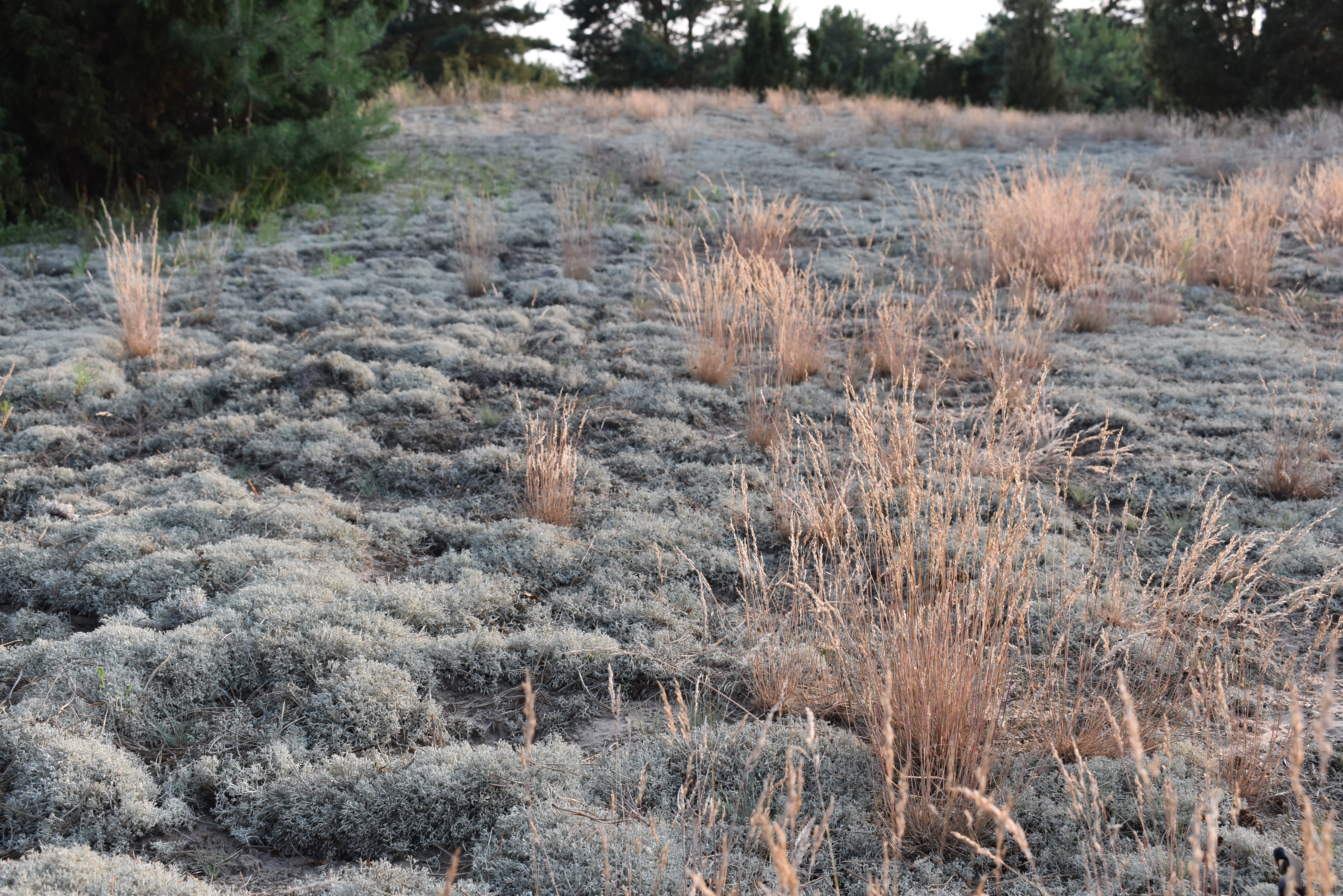
Acidic, pioneer sandy grassland with Corynephorus canescens and Cladonia species in the middle Narew valley (Photo: I. Dembiz)
Preliminary itinerary of the Field Workshop
Day 1. Sunday 24th of May
Arrival in Warsaw, possibly before noon. Departure from Warsaw and first sampling in the Narew river valley at the northern outskirts of Warsaw. Accommodation near the medieval town of Pułtusk.
Day 2. Monday 25th of May
Northern Mazovia. Fieldwork in the lower Narew river valley: dry grasslands of the Filipendulo vulgaris-Helictochloion pratensis, Sileno conicae-Cerastion semidecandri, Corynephorion canescentis, Koelerion glaucae and Armerion elongatae alliances. Accommodation near Pułtusk (same as day before).
Day 3. Tuesday 26th of May
Borderlands. Fieldwork in the Pisa and middle Narew valleys: dry grasslands of the Filipendulo vulgaris-Helictochloion pratensis, Koelerion glaucae, Violion caninae and Armerion elongatae alliances. Accommodation close to Łomża.
Days 4−6. Wednesday 27th of May – Friday 29th of May
Yotvingia. Fieldwork in the Polish part of Lithuanian Lakeland: different types of vegetation of the Festuco-Brometea, Koelerio-Corynephoretea, Trifolio-Geranietea classes and thermophilous meadows of Molinio-Arrhenatheretea class. Accomodation near Suwałki.
Day 7. Saturday 30th of May
Drive back to Warsaw (arrival in early afternoon).
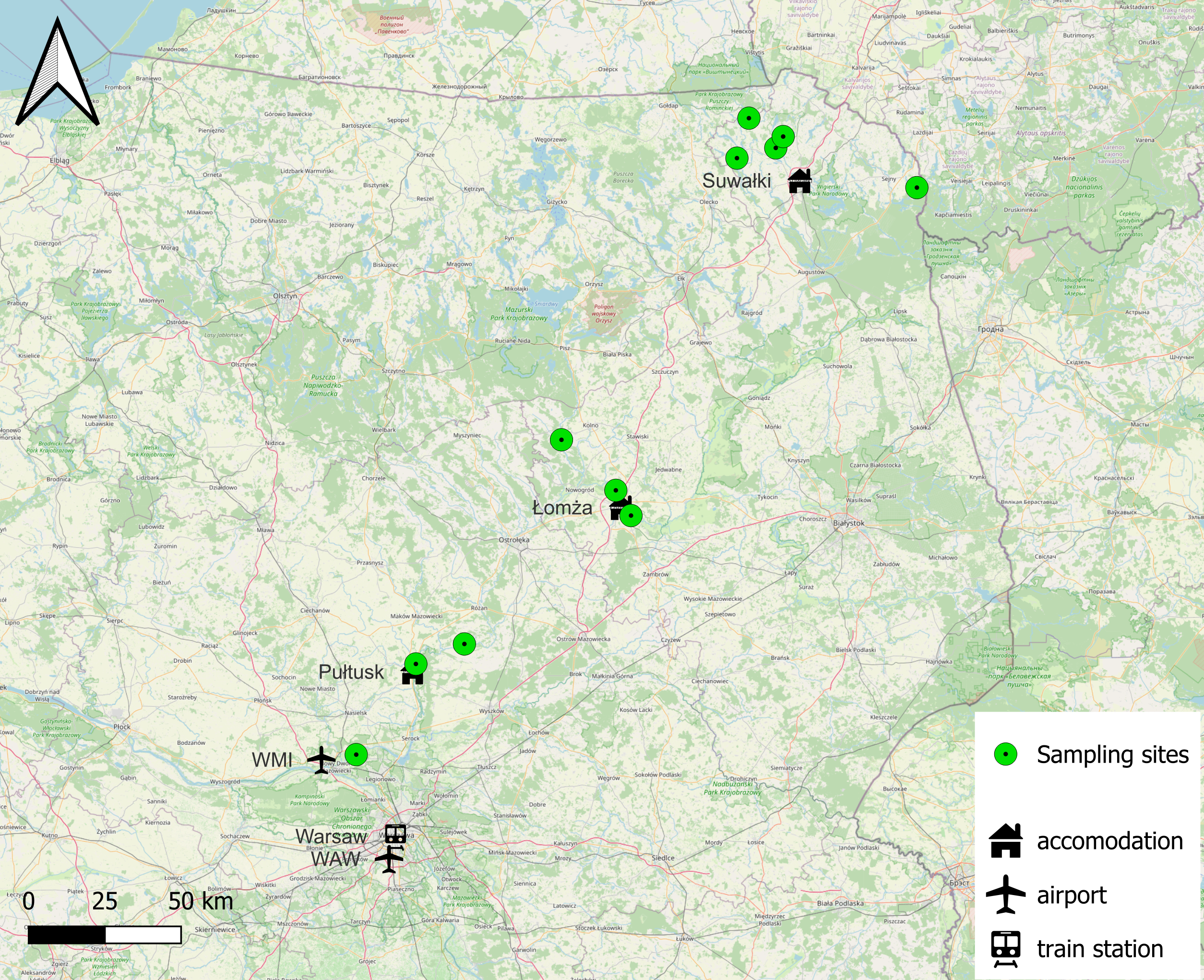
Map with approximate locations of the sampling sites of the 22nd EDGG Field Workshop in Poland (24–30 May 2026)
Accommodation and travelling
We will stay in three different accommodations during the Field Workshop. To keep the costs down and make the event more accessible, we will try to organize accommodation equipped with kitchens to allow us to prepare our own meals. Thus bring your own recipes suitable for such events with you, i.e. fast, tasty and possible to cook for a bigger group. For transportation, we will use two rented 9-seat minibuses and possibly also personal cars.
Travel information
The Field Workshop will begin in Warsaw, the capital of Poland. We aim to start on 24th of May around noon, which allows people to arrive with a night train from various parts in Europe or with a flight on the same day. The exact meeting location will be provided to registered participants closer to the start of the event. The expedition will conclude on 30th of May also in Warsaw in the early afternoon to enable most of you to travel home on the same day. Warsaw is a transportation hub, easy to reach by train, bus or plane from most of the places in Europe. As for the train travel direct international trains arrive to Warsaw from Berlin, Munich, Prague, Vienna, Budapest, Kyiv and Vilnius. As for the air travel, keep in mind that besides the main Warsaw Chopin Airport (WAW), located close to the city centre, there are two low-fare airports: Warsaw-Modlin (WMI) located close to our first sampling location (we could pick you there on our way) and Warsaw-Radom (RDO), which is located quite far to the south of the city.
Fees
The fees cover all costs for meals, travel, and accommodation, starting at 12:00 on 24th of May and ending at 14:00 on 30th of May. The fees for full participation are as follows:
- 500 EUR for students (including PhD students) who are IAVS members
- 600 EUR for postdocs, senior scientists, or other regularly employed persons who are IAVS members
- 600 EUR for students (including PhD students) who are not IAVS members
- 700 EUR for postdocs, senior scientists, or other regularly employed persons who are not IAVS members
Payment must be made via bank transfer not later than by the end of April 2026. The details of the transfer will be provided to the confirmed participants after their final approval. In the event of cancellation, we will refund the fees to the extent that the cancellation results in a cost reduction.
How to apply
Participation is open to EDGG members only, but if you are not a member of EDGG you can join it for free in the application. We expect all participants to contribute equally to sampling, plant identification, sample processing, data postprocessing, and related tasks. Preference will be given to applicants with good species knowledge in vascular plants, but particularly in bryophytes and lichens and to those who are willing to contribute to the soil analyses. For those who have not participated in several previous Field Workshops (and thus are well known to us), we ask for a short motivation letter, explaining why you are interested in participating and how you plan to contribute to the success of the workshop, both during and after the event.
You can apply for participation until 21 March 2026 via this online form. You need to provide the following information:
- Name
- Age
- Professional status (e.g., PhD student, postdoc, professor, unemployed)
- Affiliation
- Address
- Mobile phone number (for contact purposes, e.g., if you get lost in the field)
- Dietary requirements (no/vegetarian/other: please specify)
- Agreement to join EDGG (if you are not already a member)
- IAVS membership (yes/no)
- Ukrainian citizenship (yes/no)
- Motivation letter (up to 200 words) or indication that you participated in at least three Field Workshops before
- Willingness to help with bryophyte and lichen identification, soil analysis or data digitisation after the Field Workshop
Confirmation of participation will be provided no later than 15 April 2026. If the number of applications exceeds available places, participants will be selected based on the motivation letters and the competences you offer.
Travel grants
Unlike other Field Workshops, no travel grants are available for the 22nd Field Workshop as the EDGG Executive Committee has decided to allocate all travel grants in 2026 to the combined events of the 21st Eurasian Grassland Conference and the 23rd EDGG Field Workshop in Bulgaria in July this year. However, the rule that Ukrainian IAVS members are exempt from participation fees also applies for the 22nd Field Workshop.
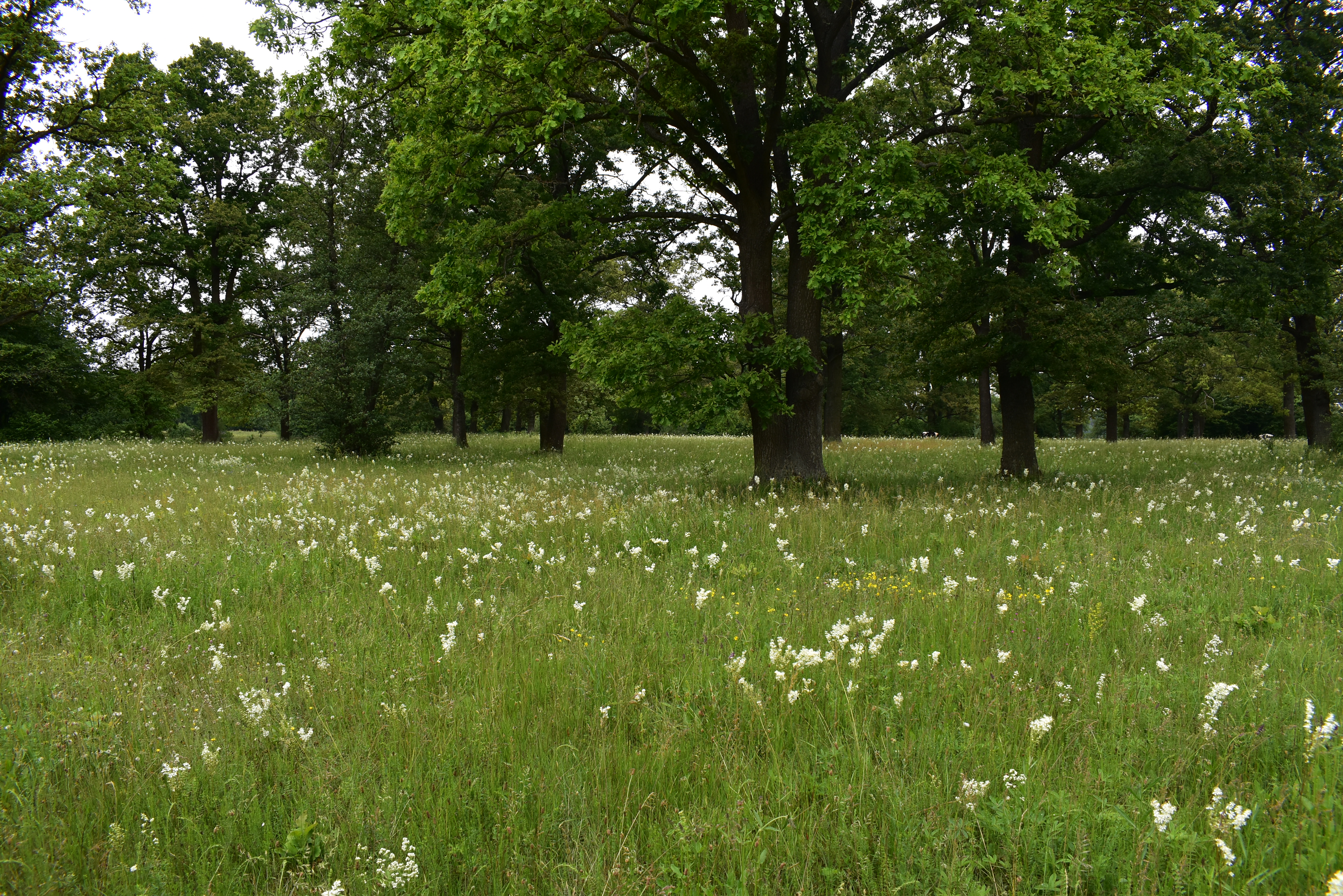
Wooded pasture with meso-xeric grassland patches in middle Narew valley (Photo: I. Dembiz)
References
Biurrun, I., Pielech, R., Dembicz, I., Gillet, F., Kozub, Ł., Marcenò, C., Reitalu, T., Van Meerbeek, K., Guarino, (…), Dengler, J., 2021. Benchmarking plant diversity of Palaearctic grasslands and other open habitats. Journal of Vegetation Science. https://doi.org/10.1111/jvs.13050
Ceynowa M. 1968. Zbiorowiska roślinności kserotermicznej nad dolną Wisłą [in Polish, with English summary]. Studia Societatis Scientiarum Torunensis, Seria D Botanica 8(4): 1–155.
Czerwiński, S., Marcisz, K., Wacnik, A. Lamentowicz, M. (2022) Synthesis of palaeoecological data from the Polish Lowlands suggests heterogeneous patterns of old-growth forest loss after the Migration Period. Sci Rep 12, 8559. https://doi.org/10.1038/s41598-022-12241-1
Czyżewska, K. (1999) Murawy napiaskowe Bolimowskiego Parku Krajobrazowego (Psammophilous grasslands of the Bolimów Nature Park) [in Polish, with English summary]. Monographiae Botanicae 85: 176–189
Dembicz, I., Dengler, J., Steinbauer, M.J., Matthews, T.J., Bartha, S., Burrascano, S., Chiarucci, A., Filibeck, G., Gillet, F., (…), Biurrun, I., 2021. Fine‐grain beta diversity of Palaearctic grassland vegetation. Journal of Vegetation Science 32: e13045. https://doi.org/10.1111/jvs.13045
Dembicz, I., Dengler, J., Czarnocka-Cieciura, M., Zaniewski, P.T., Skłodowska, K., Kozub, Ł., 2025a. Drivers of plant and lichen diversity in grasslands on mineral islands surrounded by peatlands (Biebrza Valley, NE Poland). Perspectives in Plant Ecology, Evolution and Systematics 67: 125870. https://doi.org/10.1016/j.ppees.2025.125870
Dembicz, I., Kozub, Ł., Adamska, A., Pędziwiatr, A., Jonczak, J., Topolska, K., Dengler, J. (2025) Dry grasslands of the Lesser Polish Upland: syntaxonomy, biodiversity and conservation. Tuexenia 45: 445−479. http://doi.org/10.14471/2025.45.014
Dengler, J., Boch, S., Filibeck, G., Chiarucci, A., Dembicz, I., Guarino, R., Henneberg, B., Janišová, M., Marcenò, C., (…) & Biurrun, I. 2016. Assessing plant diversity and composition in grasslands across spatial scales: the standardised EDGG sampling methodology. Bulletin of the Eurasian Dry Grassland Group 32: 13−30.
Dengler, J., Wagner, V., Dembicz, I., García-Mijangos, I., Naqinezhad, A., Boch, S., Chiarucci, A., Conradi, T., Filibeck, G., (…) & Biurrun, I. 2018. GrassPlot – a database of multi-scale plant diversity in Palaearctic grasslands. Phytocoenologia 48: 331–347.
Embleton, C. (Ed.) (1984): Geomorphology of Europe. – Macmillan, London, UK: 465 pp.
European Commission (ed.) 2013. Interpretation manual of European Union habitats – EUR 28. DG Environment, European Commission, Brussels, BE: 144 pp.
Filipek, M. (1974) Murawy kserotermiczne regionu dolnej Odry i Warty [in Polish, with English summary]. Poznańskie Towarzystwo Przyjaciół Nauk, Wydział Matematyczno-Przyrodniczy, Prace Komisji Biologicznej 38: 1–109
Głowacki, Z. (1988): Plant communities of the class Sedo-Scleranthetea of Wysoczyzna Siedlecka and the neighborhood compared with similar ones in central Europe [in Polish, with English summary]. – Wydawniclwa Uczelniane WSRP, Siedlce, PL: 122 pp.
Kącki, Z., Dembicz, I., Łukasz Kozub, Ł., Swacha, G. & Dengler, J. (2014) Invitation to the 8th EDGG Field Workshop, Pland, June 2015. Bulletin of the European Dry Grassland Group 24/25: 26–34.
Kasprzak, L., Ewertowski, M.W., Szuman, I., Kalita, J., Tomczyk, A.M. (2024). The Middle Noteć Valley—The Landscape of an Ice-Marginal Valley and Its Surroundings. In: Migoń, P., Jancewicz, K. (eds) Landscapes and Landforms of Poland. World Geomorphological Landscapes. Springer, Cham. https://doi.org/10.1007/978-3-031-45762-3_34
Kondracki, J. (1968): Fizycznogeograficzna regionalizacja Polski i krajów sąsiednich w systemie dziesiętnym (Physical-geographical regionalisation of Poland and neighbouring countries in the decimal system) [in Polish]. – Prace Geograficzne 69: 13–41.
Korzeniak, J., Perzanowska, J., Cieśla, A., Gawryś, R., Kolada, A. (eds.) (2025): Czerwona lista siedlisk przyrodniczych Polski (Red list of Natura 2000 habitats of Poland) [in Polish, with English summary]. GIOŚ, Kraków-Sękocin Stary-Warszawa
Medwecka-Kornaś, A. (1959): Roślinność rezerwatu stepowego Skorocice k. Buska (Vegetation of the steppic nature reserve Skorocice near Busko) [in Polish, with French summary] – Ochrona Przyrody 26: 172–260.
Obidziński A. (ed.) (2010): Z Mazowsza na Polesie i Wileńszczyznę. Zró żnicowanie i ochronaszaty roślinnej pogranicza Europy Środkowej i Północno-Wschodniej [in Polish]. Polskie Towarzystwo Botaniczne – Zarząd Główny, Warszawa
Smolska, E., Pochocka-Szwarc, K., Szwarczewski, P. (2024). Suwałki Lakeland—Best Example of Lowland Glacial Geomorphology in Poland. In: Migoń, P., Jancewicz, K. (eds) Landscapes and Landforms of Poland. World Geomorphological Landscapes. Springer, Cham. https://doi.org/10.1007/978-3-031-45762-3_38
Sokołowski, A.W. & Kawecka, A. (1984): Zbiorowiska murawowe Suwalskiego Parku Krajobrazowego [in Polish with English summary]. Fragmenta Floristica et Geobotanica 30(3): 287–294
Szafer W. 1977. Podstawy geobotanicznego podziału Polski. (geobotanical division of Poland) In: Szata roślinna Polski. Red. W. Szafer, K. Zarzycki. Wyd. 3. T. 2. Warszawa, PWN, p. 9—15.
Local Organizers
Iwona Dembicz, Warsaw, Poland
iwona.dembicz@uw.edu.pl
Łukasz Kozub, Warsaw, Poland
lkozb@uw.edu.pl
EDGG organizers:
Jürgen Dengler, Wädenswil, Switzerland
dr.juergen.dengler@gmail.com
Denys Vynokurov, Halle (Saale), Germany
denys.vynokurov@gmail.com